Wash your hands, face and body with our luxurious hand made soap designed to look after your dry and chapped skin.
]]>
Manuka honey – made from bees who collect pollen and pollinate the Manuka flower. This flower is native to New Zealand and, surprisingly, blooms for only 2 to 6 weeks each year. Manuka flowers are not everywhere but can generally be found in large enough areas which tend to be in the most remote and untouched parts of New Zealand.

But why is it so good for us?
Hydration for your skin
Manuka honey is a natural humectant – this means that it’s low moisture content absorbs moisture and it creates a natural barrier to keep the moisture in your skin.
This helps to keep your skin hydrated especially in winter when it is cold and prevents your skin from getting cracked and chapped during these cold months.

Naturally promotes healing
The secret ingredient in Manuka honey, compared to other honey is Methylglyoxal. Methylglyoxal is a natural compound found in Manuka honey that is responsible for it’s antibacterial activity. This compound, coupled with the honey’s ability to create a natural barrier helps to promote healthy skin and can help your sensitive skin with Psoriasis, Eczema or Acne.
Anti Bacterial and Anti Microbial
Naturally present in honey is Hydrogen peroxide which acts as a contribution towards the antimicrobial and anti bacterial properties of honey.
Anti-Oxidants keeping your skin looking and feeling younger
As a potent source of antioxidants, manuka honey helps to prevent free radicals from damaging your skin cells. These anti oxidants reduce the onset of wrinkle formation by removing oxygen from free radicals which are the lead cause of the formation of lines and wrinkles.
Try our Honey and Beeswax Soap today to support you sensitive skin >
]]>Find out how >
]]>
One of our best selling soaps is our Acne Soap or our Activated Charcoal and Tea Tree Oil Soap.
So we thought it would be good to explain why Activated Charcoal is so good at keeping Acne at bay.
Firstly, let’s be clear, our Acne Soap is designed to complement not replace medicated Acne treatment and here’s why.
What Causes Acne?
Acne occurs due to the build-up of Sebum, an oily substance that keeps your skin moisturised.
Sebum is secreted by the sebaceous gland which is located next to small hair follicles located all over your body. The purpose of Sebum is to keep your skin soft and moisturised as well as acting as a waterproofing mechanism. Basically stopping water from leaving your body.
It also acts as a barrier to keep harmful bacteria and fungal infections from your skin.
When these glands (also called pores) are blocked by dirt or oil, the sebum continues to build up. This build-up of sebum, along with dead skin cells and bacteria build and cannot get out because of the blockage.
Pretty soon this build-up becomes a nasty bulge in the skin which we call Acne.
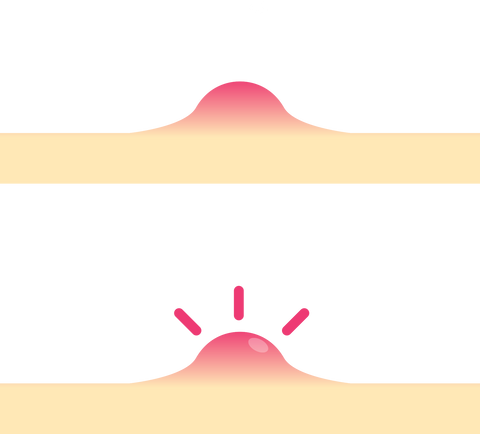
The body tries to help fight these blockages by sending extra blood and chemicals to the area which then is seen as inflammation.
Generally, Acne is characterised in two ways:
Blackheads
These are blocked pores or glands that are not fully sealed. The bacteria is exposed to the air and turns a very dark grey colour
Whiteheads
These are fully closed and blocked pores. These are the ones that become inflamed and grow as more and more blood and sebum are products.
Acne is particularly prevalent during puberty when the sebaceous glands are enlarged and hormones produce more sebum. This means that this is a higher chance of pores being clogged and blocked and for spots to be produced.
What does Activated Charcoal do?
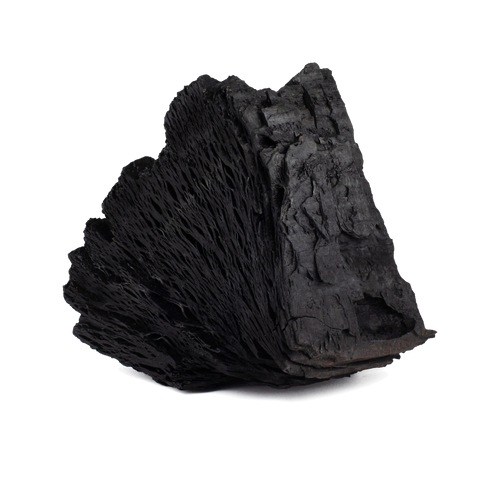
Activated Charcoal is obtained by burning materials such as woods, coal, or in the case of the Activated Charcoal used in Soapoman’s soap, the husks of coconuts.
It is burnt at very high temperatures to form a lightweight, carbonaceous charcoal which means that all of the oxygen is removed from the material.
Thanks to this method, the charcoal expands and creates a very porous surface which really effective at trapping toxins.
It is when it is in this stated that it is called “Activated Charcoal”.
The charcoals ability to absorb toxins has been given superpowers and boosted.
In addition, as a fine black powder, it also has a large surface area which means that can absorb more and thus is one of the most effective and efficient ways to clear your skin and pores of toxins.
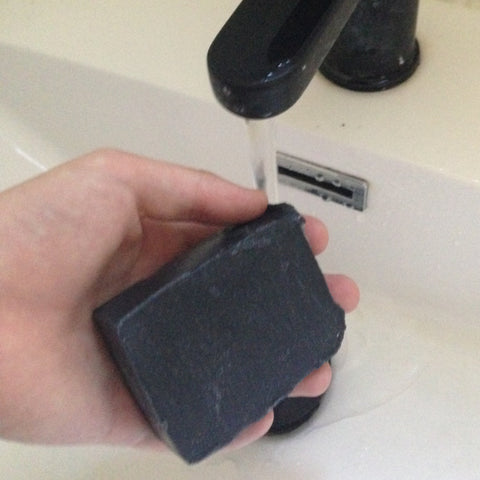
By adding activated charcoal to our soap, when you wash your face and skin, the activated charcoal gets into the pores and clears out the bacteria, dirt and germs. By helping to keep your press clean and clear of dirt and bacteria our soap can help complement your daily acne routine.
It also looks cool!
Finally, we infuse the soap with Tea Tree oil. With natural anti-inflammatory properties, Tea Tree Oil will also help to keep the redness and soreness of the skin surrounding the spot or pimple and soften the skin to help keep the acne at bay.
Click here for a link to our Activated Charcoal Soap.
]]>Find out how.
]]>

I am pretty sure that you’ve been reading a lot recently about how to keep things clean and what the best way is of keeping this horrid virus at bay.
Here at SoapOman we’ve been busy making as much soap as we can because we understand that using soap is by far and away the best way to keep your hands not just nearly clean, but really clean.
How?
It’s funny how things work because soap doesn’t actually destroy the Covid 19 virus, what soap does is to scoop up the virus and washes it away so it doesn’t get into your body.
So how does it do this?
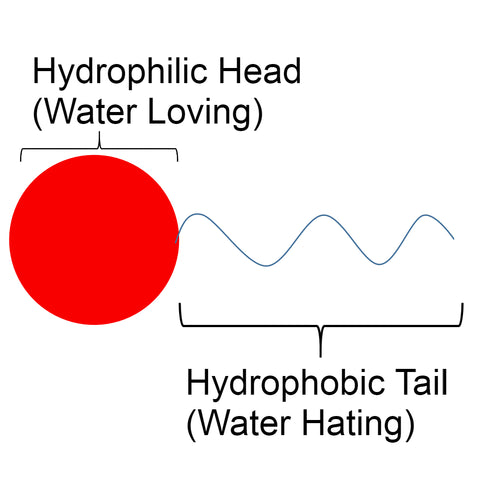
Well, soap molecules (the things that make the soap) are shaped like a tadpole and are made up of 2 parts which have got some pretty funny names:
1. The Hydrophobic (Hi-Dro-Fo-Bic) Tail
2. The Hydrophilic (Hi-Dro-Fill-Ick) Head
The Hydrophobic Tail
This is the part of the soap molecule that hates water!
“Woah, Woah, Woah” I hear you say! “Back up the bus! The part of the water molecule that hates water!! Say wwhhaaattt!”
Yes, it’s true that this part of the soap repels water and this is really important on why soap is so good at what it does.
This is the part that scoops up the dirt, germs and viruses and keeps them locked into small soap packets called “Micelles”
The Hydrophilic Head
Now, this is the really interesting part because this part of the molecule loves water. I mean it really, really likes it. It would play with water all day long if it could but it is connected to these tails, which is a real downer because they hate water.
So when these molecules find themselves surrounded by dirt, and in water, for example, when you are washing your hands, then they ll get together to create these little packets of soap called Micelle’s to scoop up the dirt, germs and viruses like the image below.
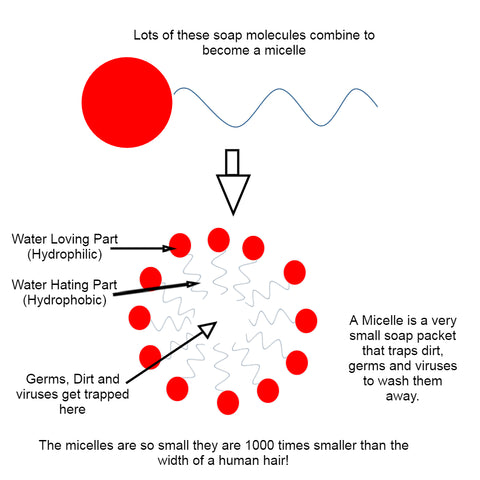
The soap micelles help to lift the dirt, germs and viruses up and off your hands and skin and break up the dirt and germs to trap it in the water-hating parts of the molecule. This part is then surrounded by the water-loving part, which stops the dirt, germs and viruses from leaving. This break up is helped by you rubbing your hands together, which also helps to spread the soap around so you can make sure all of your hands (even the back parts and between your fingers) are clean.
This does take time though and this is why it is important to wash your hands for at least 20 seconds to give the soap and the micelles the most amount of times they can have to ensure all the nasty germs, viruses and dirt are grabbed hold of.
Then, when you then rinse your hands under the water, the water-loving parts of the micelle gets drawn towards the water and the dirt, germs and viruses are simply washed away down the drain never to be seen again.
So there you go, that’s how soap works to look after and protect you and why you need to wash your hands all the time and for at least 20 seconds.
]]>